

The Foundations for AI at Sea: From Data to Decisions
Cargo handling on oil and chemical tankers is one of the most complex and safety-critical operations at sea. Every transfer requires precise cargo planning, coordination of pumps and valves, and stability checks, all managed under tight timeframes and strict safety regulations. Within the ACHT 2.0 project, funded by Trafikverket, coordinated by RISE and in collaboration with Kockumation, Bureau Veritas and Metstech, we build the foundations for AI at sea!
Combine’s task was to explore how artificial intelligence could support the planning of the cargo plans, as well as the loading- and discharging- orders. Our focus was to determine not only whether AI could technically perform this task, but also how it could be integrated safely and meaningfully into existing maritime workflows. To answer that, we developed and tested a proof-of-concept model and created an API that connects to Kockumation’s Loadmaster X5 system. Together with Kockumation, we designed a UI to ensure the interface meets the needs of officers on board and facilitates improved data collection.
Building the Foundations: Understanding the Data
Combine’s work in ACHT 2.0 began with a deep look into the available data. Cargo planning relies on many different data sources (loading plans, pump logs, voyage reports, product lists, and more) often stored in different systems and formats. Early in the project, it became clear that for AI to play a meaningful role, this foundation needed improvement.
Across vessels and operators, data quality and structure varied significantly. Teams stored files often locally, have different formats, and have inconsistencies in essential metadata such as timestamps, port names, or product identifiers. To move toward reliable AI support, we needed a clearer, more standardized data landscape.
Based on this, Combine proposed a structured data framework for future operations: replacing free-text fields with controlled inputs, standardizing naming conventions, and ensuring that key operational details, such as port identifiers and cargo properties, are recorded systematically. These changes will not only improve data quality but also make it possible to build stronger, more generalizable AI models in the future.
Exploring What’s Possible Today
With that understanding in place, we turned to the next question:
What can AI already do with the data available today?
To explore this, Combine developed and tested a proof-of-concept model that uses historical data from real voyages to recommend safe and efficient cargo plans. By identifying similar past operations, the model suggests validated plans as starting points for new ones, supporting faster and more informed decision-making without replacing human judgment.
Combine also created an API that connects the AI model to Kockumation’s Loadmaster X5 system. We developed the design of the user interface jointly, ensuring that it fits naturally into officers’ existing workflows, and enables fore structured data collection.
We tested the proof-of-concept successfully in simulator environments at the Donsö Maritime Training Centre, where bridge officers interacted with the system as they would in real operations. Their feedback confirmed that AI can integrate smoothly into current planning routines, as a trusted assistant that enhances, rather than replaces, expert decision-making.
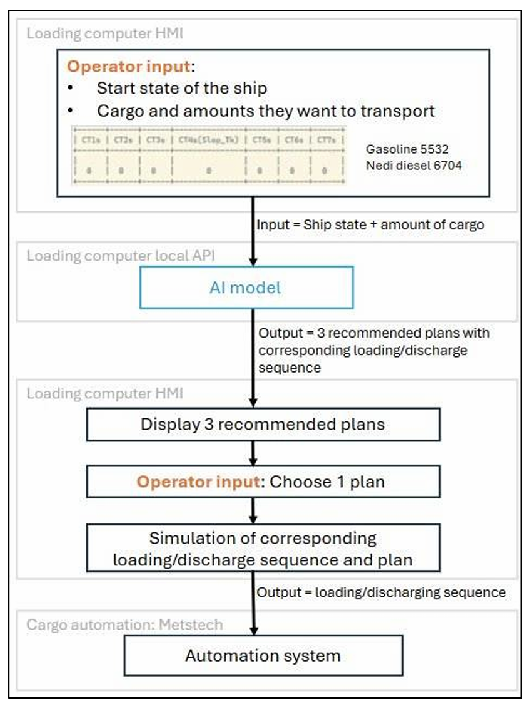
the integration of Combine’s AI model into the Loadmaster X5 software from Kockumation.
Looking Ahead
ACHT 2.0 shows that AI can be a valuable tool for supporting complex maritime operations. The next steps are to expand data coverage, deploy the API in live environments, and continue refining both the model and the underlying data structure based on real-world use.
With each iteration, these systems will become more capable, moving from assisting with historical plan selection to predicting and optimizing future operations. It’s a gradual evolution, grounded in safety, transparency, and collaboration.
At Combine, we see this as building the foundations for AI at sea: a future where data and human expertise work hand in hand to make operations safer, smarter, and more efficient.
Interested for more?
The full report for Trafikverket can be found here: ACHT 2.0 Project Report
.
Feel free to contact us for more information or if you see any similarities to your AI journey!