
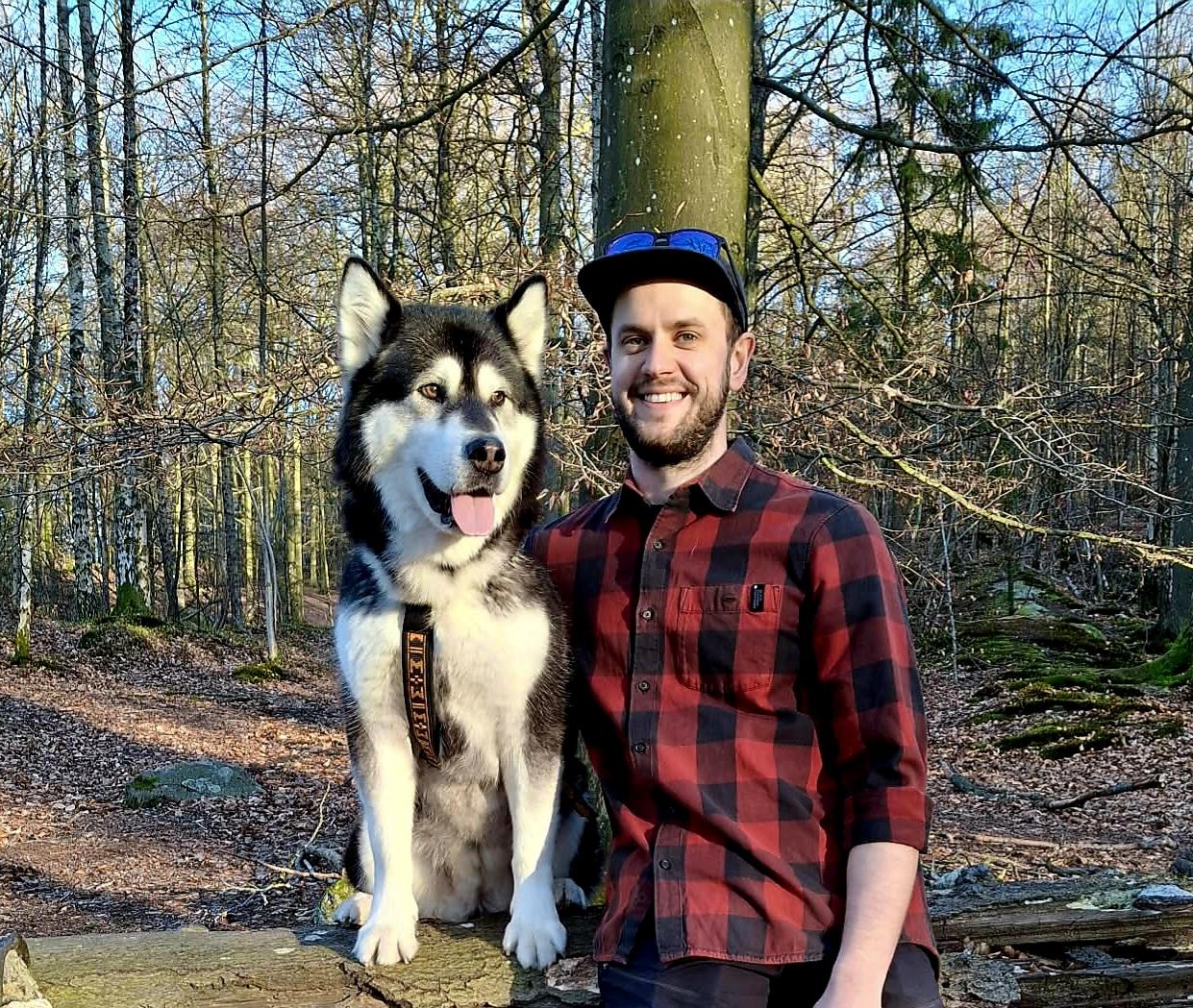
Meet Evert
Student life is fun. But for many engineers, the truly interesting years begin only after graduation – when theory meets real problems, real customers, and technology that doesn’t always behave the way the textbook says it will.
Evert Häggman has worked in the industry for about five years. We asked him nine quick questions about how he got here, what still makes the job fun, and where he’s headed next.
01Who are you?
I live in Gothenburg and work as Tech Lead Controls on several of Combine’s in-house projects – work that revolves around IIoT, mechatronics, and robotics.
02What did you study – and why did you choose that?
I studied space engineering in Luleå, with a master’s degree focused on Spacecraft & Instrumentation. At its core, it’s an engineering physics degree with a space focus.
Actually, it was a master’s in aeronautical engineering that drew me in from the start. But once I’d moved up to Luleå, I found out it had been discontinued. By then I’d already moved clear across the country, so space engineering it was instead.
03What’s the most fun technical problem you’ve solved in your career?
It’s hard to pick just one – there have been genuinely fun moments in every project I’ve worked on. What I enjoy most is using math and physics to find inventive solutions.
For example, we built a proof of concept for an optical encoder to make an entire sensor setup contactless without adding cost. We’ve also had a really fun metrology project for a customer, where I got to be involved the whole way – from the idea stage to a finished product.
04What makes the consultant role fun after a few years in the industry?
The variety. I get to dig into different technical problems and carry what I learn from one project into the next. There’s always something new to learn.
05What do you get to do as a consultant at Combine that you might not get to do elsewhere?
Above all, it’s the customer projects we run in-house – something Combine has invested in for a long time. That’s where I get closer to the customer in a different way, and also get to see how decisions are actually made.
06What kind of problems or technology do you hope to work with in the coming years?
I think AI is opening the door to more interesting solutions in robot-as-a-service, bio-robotics, and automation. As software can be developed faster, it’ll be exciting to see what we can achieve together with new hardware. That’s the kind of technology I’d like to help build.
07Technology is moving extremely fast right now. How do you stay up to date?
It’s hard to keep up! I follow Weekly Robotics, among other newsletters, to see what’s happening around the world. I also learn a lot by trying out new techniques on projects and talking things through with colleagues.
08How do you use AI in your work today?
I write considerably less code myself than I did a year ago. Now I spend more time on planning and defining requirements, and I use AI to generate code that I then review and refine.
09If you met yourself as a newly graduated engineer, what advice would you give yourself?
Trust “learning by doing.” Theory is a good foundation, but reality is often more complex than the models. Dare to try things and take on new problems – that’s how you learn and grow.