
Thinking about drones for your business?
Start with simulation – not hardware.
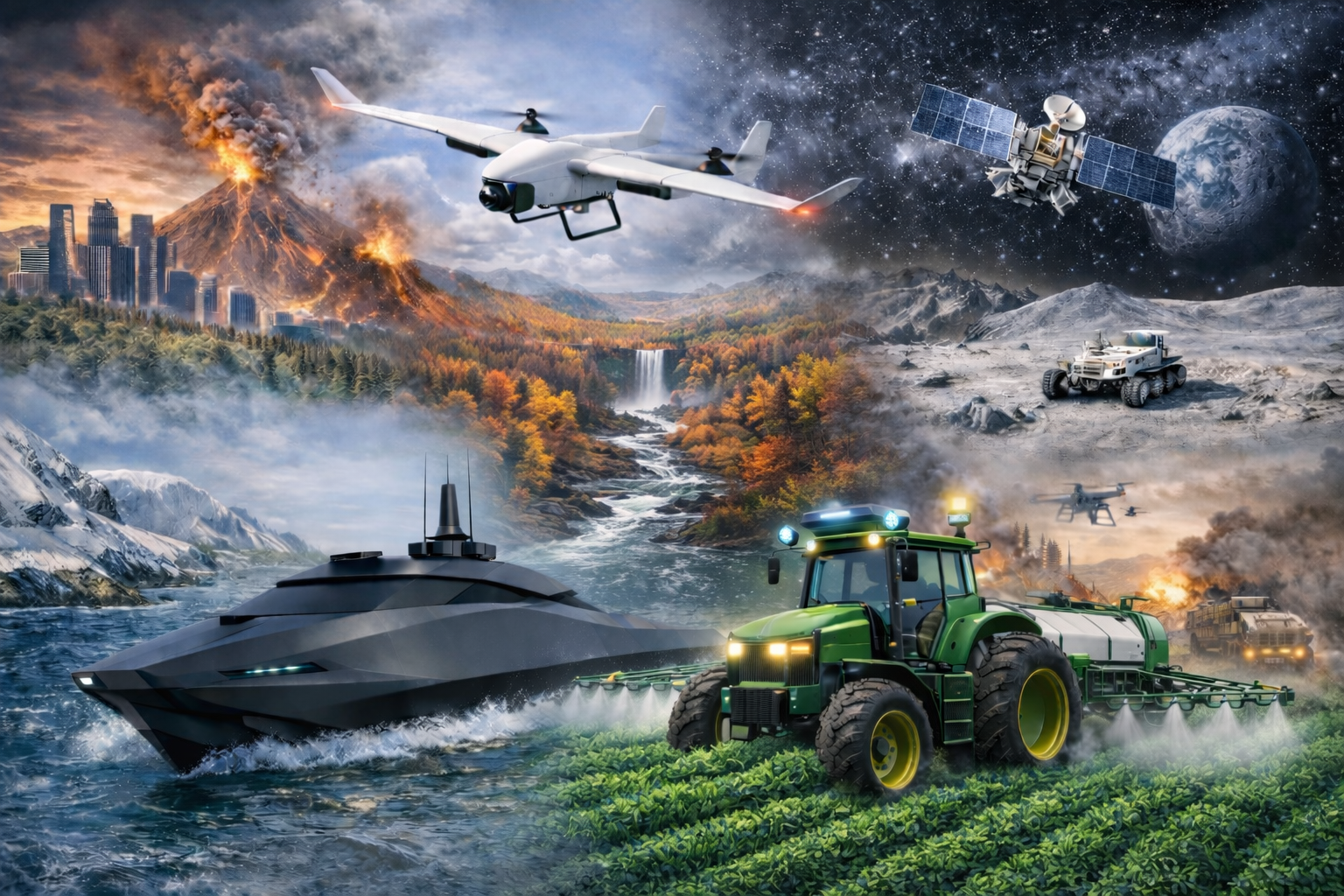
The image above tells a familiar story. Autonomous systems operating across air, land, sea — and even space. Drones coordinating with satellites. Vehicles navigating harsh terrain. Agriculture, disaster response, defense, exploration. What connects all of this isn’t a specific vehicle or platform. It’s systems thinking.
Across logistics, inspection, energy, construction, agriculture, and public safety, more organizations are asking the same question:
“Should we involve drones in our business?”
By the time that question is asked, the market is often already crowded.
Competitive advantage in the drone domain rarely comes from buying hardware early. It comes from choosing a different path — one grounded in early modeling, drone simulation, and system-level understanding.
At Combine Control Systems AB, we help customers explore, validate, and shape drone-based business concepts before they make large investments — by using control systems engineering, data science, ML/AI, embedded software, and simulation-driven development.
Why drone simulation-first changes everything
Traditional drone projects often begin with hardware procurement and manual testing. This makes the process slow, costly, and unforgiving. Fundamental assumptions about autonomy, sensing, communication, and real operating environments are only tested once choices are already locked in.
The systems shown in the image above would be impossible to build safely and economically that way.
Today, we can explore entire drone missions and autonomous systems virtually.
In early Software-in-the-Loop stages, teams can test business ideas, mission logic, autonomy levels, and edge cases at very low cost. Weak concepts fail early and strong ones gain clarity and momentum.
As confidence grows, real autopilots and embedded software are introduced through Hardware-in-the-Loop. Most unstable behaviors and integration issues are discovered before real-world operation. Therefore, progress becomes iterative, predictable, and scalable.
An open ecosystem — used deliberately
Few technology domains are as accessible as autonomous systems and drones. Open software, modular architectures, and global collaboration enable rapid experimentation across domains — from agriculture to aerospace.
The challenge is not access. It is making the right technical and business decisions early enough.
That is where systematic modeling, simulation, and control-centric engineering make the difference.
What Combine Control Systems AB brings
We work at the earliest and most decisive phase of autonomous system innovation:
- Strategic guidance on viable niches and use cases
- Simulation-driven concept exploration and validation
- Control systems, ML/AI, and embedded software development
- A clear path from virtual models to real-world systems
If drones — or autonomous systems more broadly — will play a role in your future business, the smartest place to begin is not with hardware. It’s with a model.
Curious to dive deeper into drone simulation?
If the systems perspective in the image resonates with you, we invite you to explore how we work with simulation, autonomy, and complex systems in practice. Our recent articles dive deeper into virtual commissioning, open-source ecosystems, advanced autonomy concepts, and applied research at the frontier of control engineering:
-
Virtual commissioning and simulation-driven development
-
Building robust systems on top of open-source foundations
-
Multi-domain autonomy and the future of drone swarms
-
Research-driven autonomy at the AIAA SciTech Forum
These articles show how early technical insight turns into real business impact.
Let’s build it right, from the beginning.