- Industry
- Automotive
- Result
- 94.3%estimation accuracy on realistic scenarios
- Published
Assignment
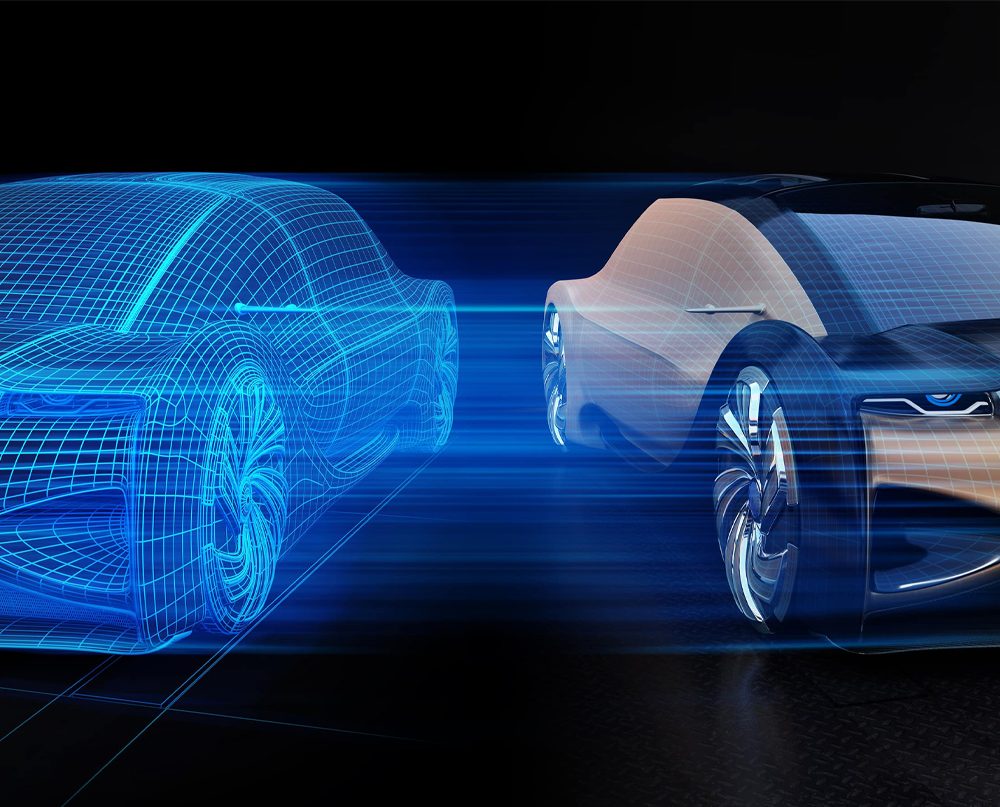
The demand for trustworthiness in modern vehicles is rapidly increasing. Becoming more autonomous, featuring a large set of advanced driver-assistance systems (ADAS) such as electronic stability control, lane departure warning systems, anti-lock brakes, and several others, the responsibility is in a transition phase from driver to vehicle. For the systems to be trusted, vast and high volume, testing is key. Tire-road friction estimation has been found to be one of the most important factors in avoiding crashes and is crucial to the performance of safety systems. But the coefficient of friction is difficult, not to say impossible, to measure in the real world. By using a digital twin we can fully control the coefficient of friction and thereby also measure it. During this assignment a digital twin has been modeled and has been training a neural network in order to estimate road friction.

The strategy that got a working neural network
The work can be divided into three major parts: vehicle dynamics modeling, simulation and AI using deep learning and neural networks. A key factor to get a basis for friction estimation is to have accurate approximation of the vehicle dynamics such as the physical properties and tire model. A digital vehicle was developed in Unity 3D on data provided from the National Electric Vehicle Sweden AB (NEVS). The digital twin was an important phase since it concretizes the problems that arise and vital testing for an accurate result in a complex environment can be performed. Furthermore, the coefficient of friction could be measured and used as training data for the estimation model. It was also possible to set up an extensive matrix of thousands of driving scenarios, all configurable, repeatable and available at the push of a button.
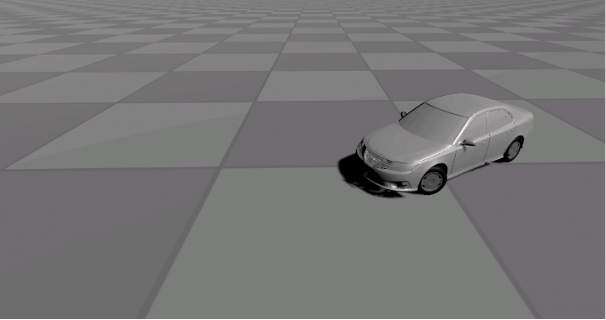
When test scenarios were generated with four different states of the road: ice, snow, wet asphalt and dry asphalt they were simulated in the digital twin. The resulting data was used to train a neural network for robust estimation of friction. After training, the neural network was validated in the digital twin with new data.

The challenges of working with the model
When developing a model, lots of variables must be accounted for. It can always be improved and optimized and by using a digital twin it was possible to recognize that. By simulating instead of doing real life testing, it opens the door for even more testing since the time span of every test is drastically decreased, from minutes or hours to seconds and milliseconds. The challenge though, is to get the simulation as close to the real environment as possible. A small difference from reality when creating the digital twin can have an impact on the outcome.
Results
In an optimal scenario, where the neural network has been trained on driving scenarios that are similar to reality and the neural network is evaluated on and little model mismatch, the network reached an estimation accuracy of 94.3%. However, when the network was evaluated on driving scenarios that were dissimilar to the training scenarios, and using a lot of model mismatch, it estimated up to 73.7% correctly.
A conclusion from this is that the digitalization process can be highly beneficial if used in a way where the difference between the physical and the digital vehicle is minimized and the model is trained on scenarios close to reality. If the process is used in an adverse way, only a set of additional errors have been introduced.
This case concretizes how a digital twin can cut cost and time in your product development when simulated correctly. It also shows the endless possibilities and great impact the digitalization can have on future products.